.gif)

|
|
|---|
2000's
|
 2000's |
|
No set of "exhibits" such as this would be complete without a few Indian-mascot examples from the contemporary sports world. My take on why they are demeaning, aside from sheer pejoratives such as "Redskins": it's yet another conflation of the Native with the "wild," the primitive, the "animal." That is, the Cardinals and Diamondbacks and Indians are—literally—on the same playing field. (There are tribal worldviews that consider the Native and other species as analogous in a far different fashion, as "close kin," in fact; but this is hardly the ideology behind the popular iconography.) . . . As for recent agreements by certain tribal officials surrendering the use of their names to local sports teams (read: FSU): just because some "chief"-of-a-bureaucrat sells the tribal name down the river, that doesn't make it right. [Pictured: Cleveland Indians; Florida State Seminoles; Washington Redskins (2):] |
    |
|
|
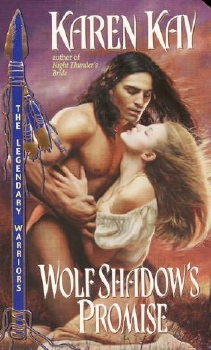
A relatively recent pop-literature genre is—as I would call it—the "Native American Harlequin Romance." As the book cover on the right demonstrates, the "Harlequin" formula of a heroine in the thrall of a beguiling stranger is there, all right, but we have the additional treat of "Noble-Savage-meets-Buxom-Paleface." Our traditional "tall, dark stranger" now brings a delicious racial exoticism and tension into the equation, evidenced in the following web-blurb excerpt from the novel (published in 2000):
|
 |
|
Like the Firesign Theater selection, this is more of an anti-exhibit. Coeur d'Alene/Spokane author Sherman Alexie's poem, "Crow Testament" (from One Stick Song, 2000) not only plays on the association of Natives with animals of an often "reprehensible" reputation (i.e., the crow), but also presents the bird as the prototypical Native trickster, with a postmodern spin. After the hilarious section 6, the final section is a sad intimation that even many contemporary Indians no longer recognize the "deity" that such a figure connotes: |
1. Cain lifts Crow, that heavy black bird Damn, says Crow, I guess 2. The white man, disguised Damn, says Crow, if I could swim 3. The Crow God as depicted Damn, says Crow, this makes it
6. Crow flies around the reservation but they are so heavy So, one by one, he returns them Damn, says Crow, redemption 7. Crow rides a pale horse Damn, says Crow, I guess |
|
The stereotypes live on (570 AM/92.3 FM; Omaha, NE; 8 Sept. 2005): |
--MIKE TYLER [after describing getting "shit-faced" drunk in Watertown, SD]: I never felt more Indian in my life. [To great laughter from Todd & various hangers-on/sidekicks.] | |
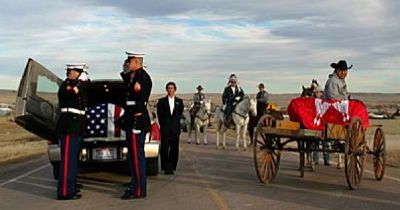
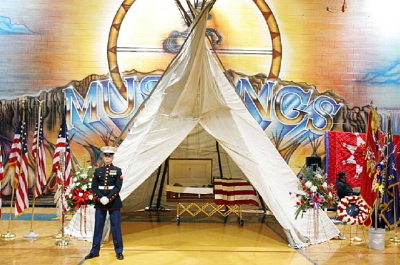
From the legendary Ira Hayes and my own great-uncle Percy in WWII, to the 2nd Iraqi "conflict," Native Americans have served their colonizers/conquerors well, as "warriors" after the "Indian Wars." Indeed, as an economically impoverished minority group, we have served disproportionately, most likely, in the last several U.S. military engagements. (Thus it is no surprise that the first U.S. female casualty in the current Iraqi engagement was a Hopi woman.) I have such mixed feelings, then, about Lakotas fighting in Iraq that I'll keep my mouth relatively shut in presenting these excerpts from an anonymous Powerpoint presentation I received in 2006, called "A Wake for an Indian Warrior," though one can't help but note the ongoing cultural contrasts evident in the photos: |
"Bands of warriors: U.S. Marines prepare to transfer the flag-draped casket carrying Cpl. Brett Lundstrom, 22, from a hearse to a wagon last Saturday on the road leading to Kyle, S.D. 'He earns the American flag from his government,' says Vietnam veteran John Around Him. 'He earns the eagle feather from his people.'"
"Home of the Mustangs: The body of Marine Cpl. Brett Lundstrom, who was killed by small-arms fire Jan. 7 in Fallujah, lies in state in a flag-draped casket inside a 30-foot tepee set up in the gymnasium of Little Wound High School on the Pine Ridge Indian Reservation. U.S. Marines took shifts standing guard at the entrance." |
|
|
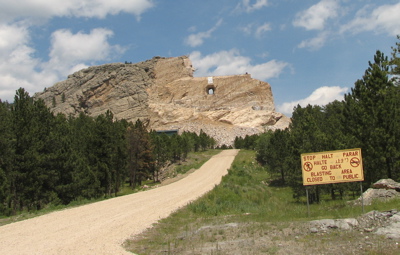
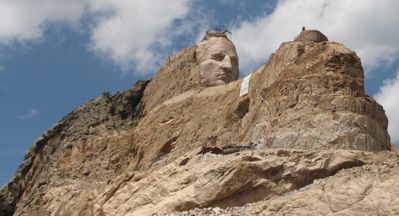
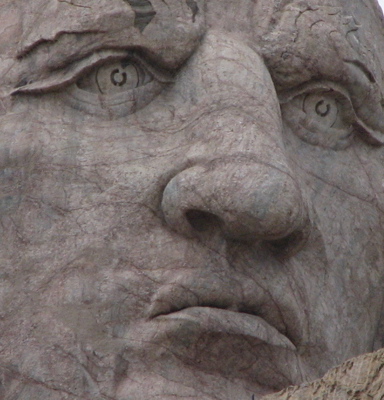
Assuming that most of you have seen facsimiles (all in pure "white marble"!) of the intended final product-—with Crazy Horse on horseback, his arm outstretched towards some grand enterprise or dream—here is a relatively recent photo
Update: These are (now) a few of the picts my daughter Emma & I took just this summer (June 2006). We had the bad luck of showing up on the sculptor's wife's birthday—ergo the rather untoward white signs on the sculpture's arm, regarding her 80th year. . . . My political views thereof have not changed. |
|
|
|
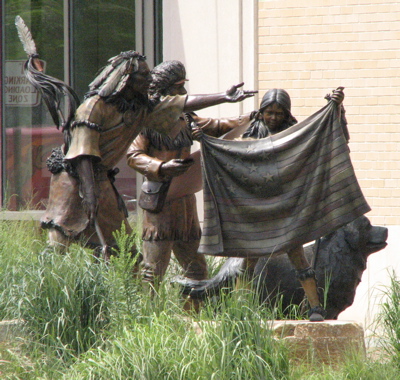
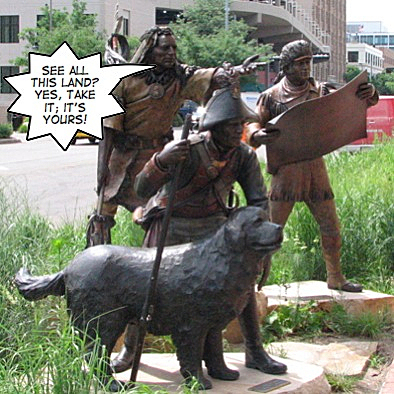
Outside the Center for Great Plains Studies in downtown Lincoln, NE, is a set of statues called "On the Trail of Discovery" (by George W. Lundeen, 2004). My reading thereof should be obvious by now: what has been really "discovered," at last, is the helpful "savage" saying, "Take this land—it is yours!" (Cf. the Crazy Horse sculpture's outstretched arm?) Worse yet, the Native youth displaying the U.S. flag is another blatant iconographic act of colonialist wishful thinking, of coercive co-optation. (Cf. the Firesign Theater script:)
|
|
|
That such a cheeky "playing Indian" (at the 2007 Grammy Awards) is done by another minority group doesn't make it any less insulting; and it may be even sadder [credit/thanks to a former student]. |
||
|
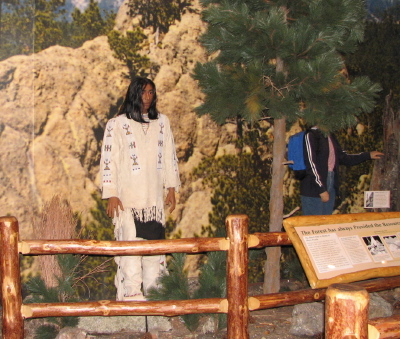
In The Journey, a museum in Rapid City, SD, humankind's concern for the environment is emblematized in a two-part exhibit, with a definite value-judgment timeline implied. On the left side of the presentation [1st photo] is an archetypal Indian, as it were, living as one with the land—although, frankly, he looks rather stunned just to be alive.
In the 2nd photo (the Native guy can still be seen, now on the far left), the Euro-American—or, the "new & improved man"!?—has a similarly healthy concern for the environment; moreover, with the aid of charts and graphs and Darwinian science, this dapper fellow must be considered even more eco-conscious: indeed, he is a fine tribute to human evolution, to the advance of civilization itself. [photos by TCG, 6/07 . . . Oh, my daughter tells me that the person on the right is a woman! Still hard to tell from the larger version of this photo, but now I think she's right.] |
|
|
A student of mine's relative just received the following in the mail (September, 2007). Now, I've been driven around St. Joseph's by a Chamberlain (SD) friend, and I know another fellow who works there, and I have nothing against this school specifically, other than its role as a belated remnant of the Catholic-Indian-boarding-school tradition. But: this "gift box" mailing cover is pretty sickening. Wow, these cards are "from the Lakota children!" (all Catholics now, of course); and I guess the bourgeois houses-in-the-country scenes are truly representative of contemporary Native housing. Oh. Wait. They're all white kids in these pictures. Except for the card about the (Middle-Eastern) Three Wisemen. Hey, you couldn't do a "Three Little Indians" card, at least?! 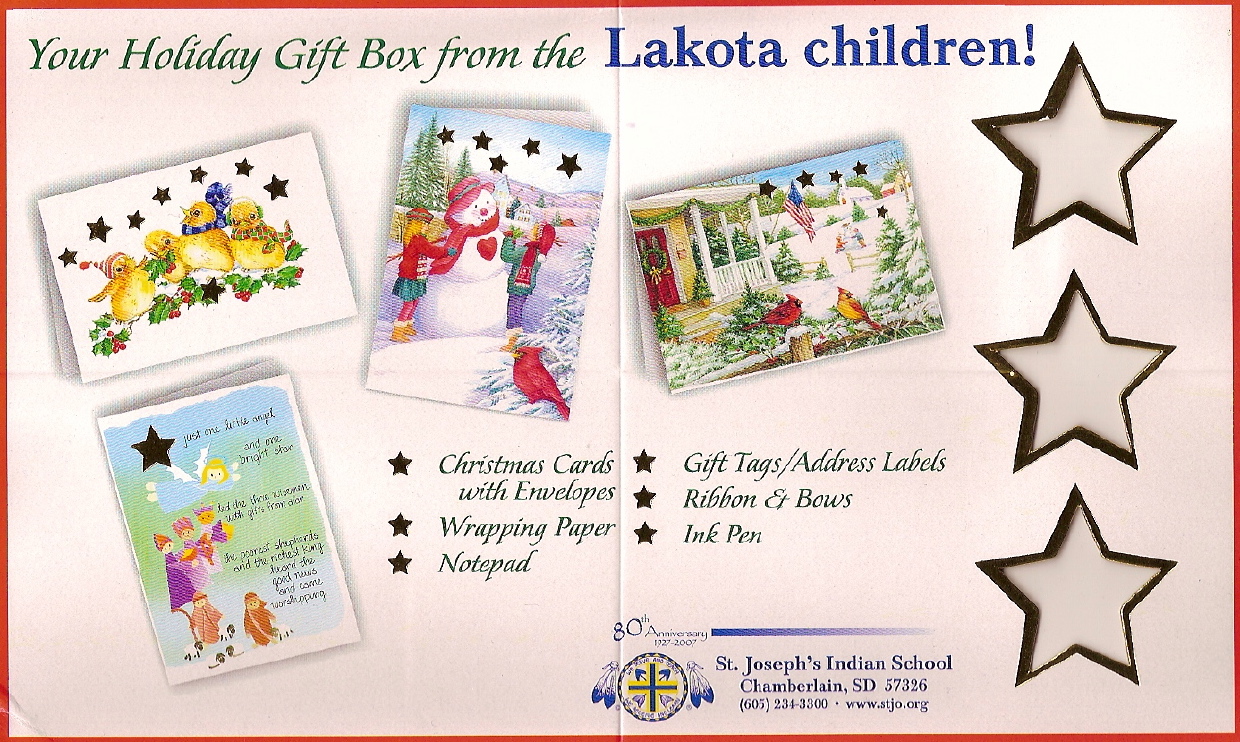 |
||
|
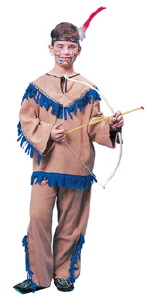
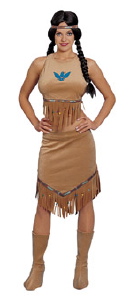
Costume SuperCenter(.com) offers the following among their holiday merchandise (Nov. 2007): 1) the "Indian Boy Child," for that "dirty white boy" who wants to get even dirtier & bloodier with some bow-hunting action—and circus-clown face paint; and 2) the "Indian Babe Adult," for the discerning hottie who wants to practice her flirtatiousness as another ethnicity: |
|
|
|
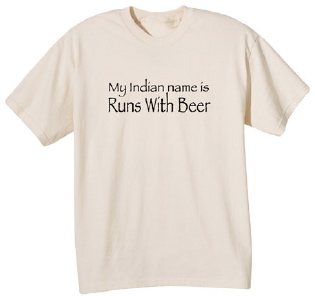
I recently received a wonderful mail-order catalogue called What on Earth: A Collection of Fun Wear & Delightful Diversions (Holiday Preview 2007 edition). The fun includes wearing a t-shirt or sweatshirt that sports a "delightful" racial slur/stereotype: |
|
|
|
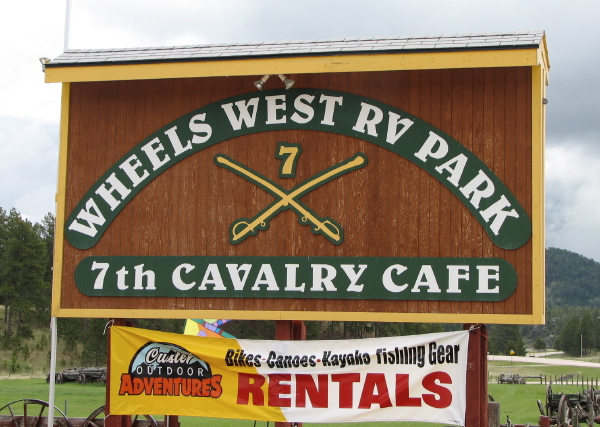
In the southern Black Hills of SoDak, between the township of Custer and Custer State Park (sheesh!), I came across this business establishment, the name and logo of which brazenly or blithely-blindly celebrate one of the low points in American history. Scarier yet, the sign, at least, is pretty new, and I don't remember ever seeing this place the scores of times I've driven this road over the years. In other words, the ideology underlying such a celebration lives on in this day and age: I don't expect that the town of Custer will ever change its name; but for this hagiographic b.s. to keep cropping up in the 21st century?! . . . |
 |
|
|
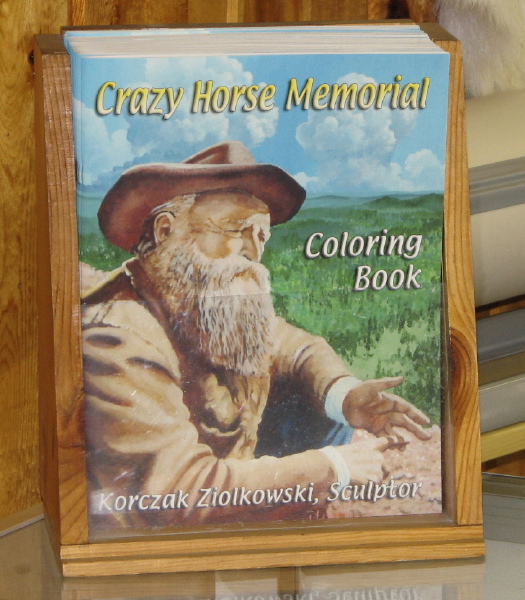
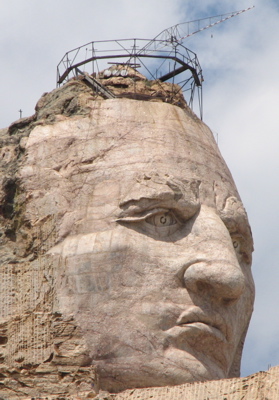
The 2nd and 3rd photos here (below) are updates of the progress at the Crazy Horse Monument (May 2009). My daughter and I last saw it three summers ago, and when she saw the picts, she said, "Daddy, I can't tell any difference!" Pretty much the truth. (Well, the hole's bigger, and the long ledge—his arm?—more level.) I told her she'd better have a kid or two, so that maybe they can see its completion—in their old age? The first picture was taken in the Visitor Center's book (and assorted kitsch) store. Yes, there's a coloring book for sale. Hey, it's not just a face on (and a defacing of) a mountain—it's a franchise! |
|
|
When I first saw this product in a Rapid City convenience store on my recent road trip back through SoDak (2009), I thought, "Oh, no—not again!" When I saw them a few days later in a store in—ironically—Custer State Park, I broke down and bought one. It wasn't bad, although I find it hard to consider any such "snack" item to be worth $2.79. . . . But it's actually a pretty laudable product, made on the Pine Ridge Rez (Kyle, SD), and aimed, according to its promos on the web, at re-introducing a more traditional Lakota foodstuff to a people succumbing too often to diabetes due to a Western diet of processed foods. (It's based on wasna, a Lakota mélange of buffalo meat and berries, often chokecherries. This commercial version uses cranberries from Wisconsin instead.) No, my take-off point for this "grump" session is the word Tanka in its name—or more to the point, and what I noticed on this trip: the proliferation of the use of Tatanka by Black Hills (mostly white) businesses, as if jumping on an "Indian" bandwagon. It's not "Buffalo" this or that anymore; it's "Tatanka Lodge" and "Tatanka Gas & Go" and (I'm waiting for) "Tatanka Ketchup." And then this bar's name is "Tanka," and while I know from my research that its marketers must know that tanka means simply "big" or ("great"), it's a good guess that most South Dakotans assume that it means "buffalo," especially given the red bison logo on the packaging. (Okay, maybe I'm ranting about nada here. But I did want to share my scan of the cool package.) 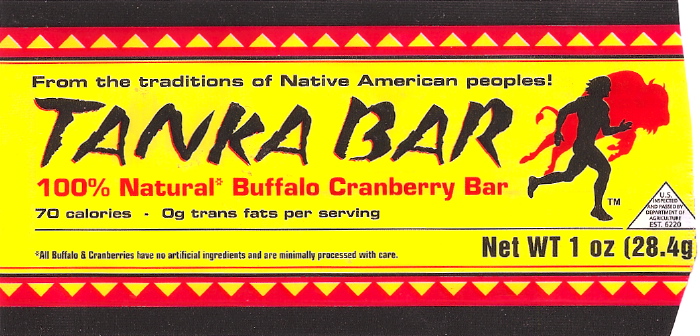 |
||
|
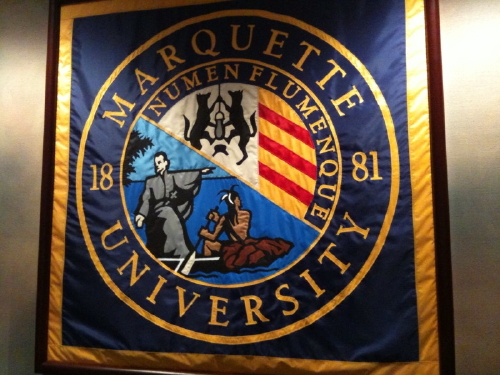
That's the translation of Marquette's Latin motto, Numen Flumenque. This is a contribution from yet another student of mine, who sent me this iPhone photo and noted the "problematic insignia." How "divine" is the black-robe priest with arm and index finger pointing the way, over a subservient rowing Native? I gave a talk on my experience with the Jesuits and my own Indian boarding school experience just last week (8/09), and this is the same domineering colonial & proselytizing ideology that I experienced. "Oh, thank you, Marquette, for founding yourself in 1881. It's only nine years until Wounded Knee. And your branch of religious bigotry played no small role there!" |
|
|
I can't even believe this stuff is still going on. (The immediate culprit: the online Coed Magazine, 16 Nov., 2009; and credit/thanks to another former student). It's also comes as no surprise that (almost) none of the "Poca-Hotties" pictured below the following title banner proclaim any Native blood; they're all just "dressing up" and "having fun," often in obvious paid-model-shoot milieus. A friend of mine expressed surprise at my anger and asked, "What if it were a page of 'Irish' hunks, clad in a little Celtic green but mostly bare-skinned? Totally make-believe and good-natured fun, like Saint Patty's Day. What's the difference?" (The direction of this conversation stems in part from the fact that we both have some Irish blood.) I replied that a contemporary Irish-American didn't grow up commonly hearing his mother called awful, hurtful racist epithets. I did grow up hearing my mom called a "squaw." . . . . One final quibble: if you're from a tribe associated with a "totem pole," you're probably going to have a hard time acquiring a "wampum necklace." A quibble maybe, but it reveals the ignorance that inevitably accompanies racism. 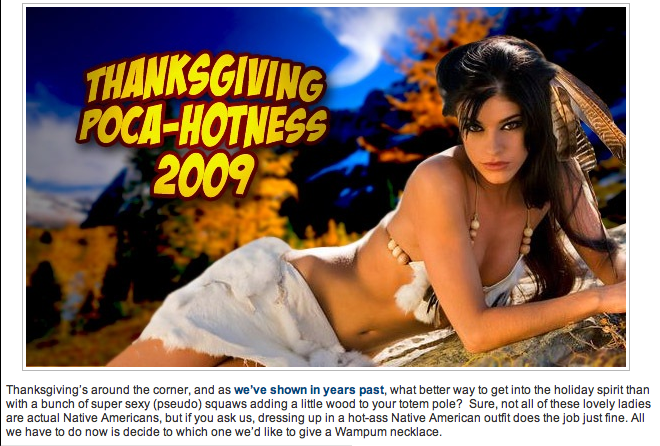 |
||
It's been something of a relief to teach Native American literature at a school whose mascot is an ostensibly innocuous Cornhusker, the representations of which on the football field seem more silly than anything else. (And the fans' "corn-head" hats are even more so.) But this is also the university whose motto is "Pioneering New Frontiers," and "we" didn't get to be the state of the great monocrop—oh, Children of the Corn—without a good deal of "pioneering" spirit in the form of Indian removal and land theft. This photo is of a recent U of Oklahama vs. U of Nebraska game (7 Nov., 2009). These students' rationale for dressing up like Indians is unclear; but the sign "We Want Our Land Back" can only be read as painful irony. 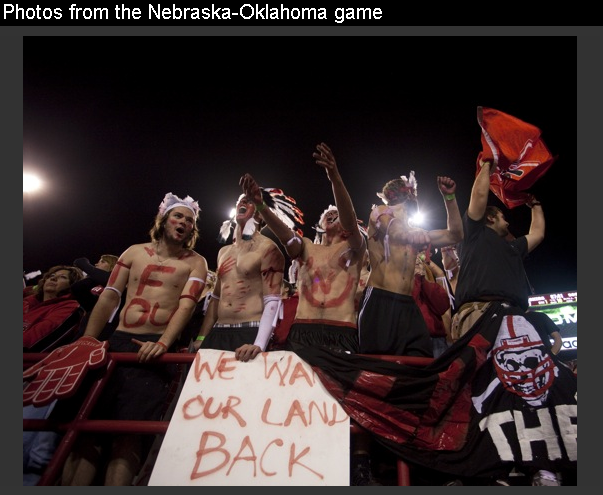 |
||
.gif)

.jpg)
.jpg)